START
Starting VAT
Approaching the registration threshold, registering or preparing for the first return.
Registration assessment, setup and first return
Reliable VAT returns start with accurate records, reconciliations and the correct VAT treatment.
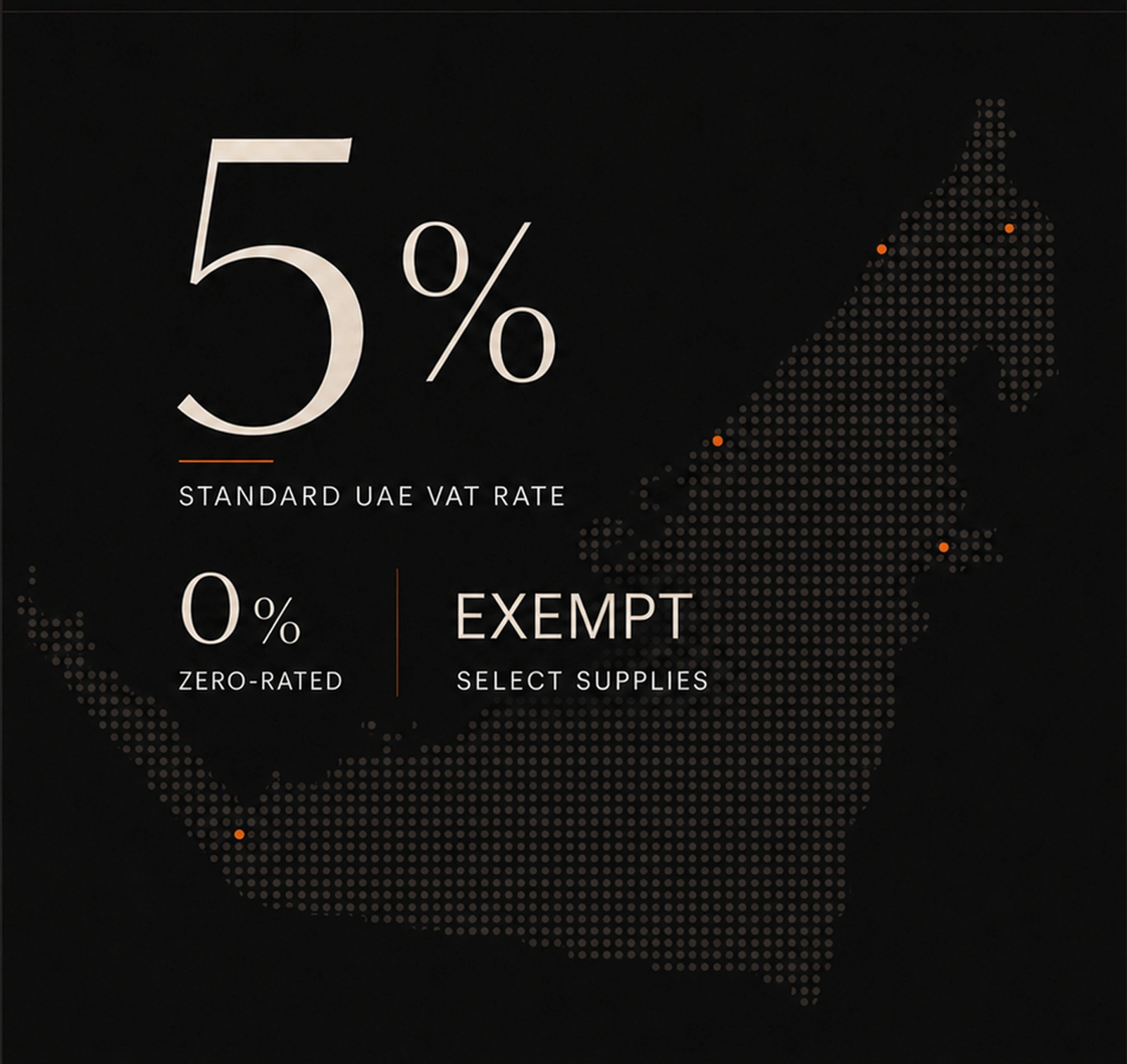
VAT support should reflect what stage your business is in, from registration and recurring filing to operational change or deregistration.
START
Approaching the registration threshold, registering or preparing for the first return.
Registration assessment, setup and first return
ONGOING
Managing return preparation, reconciliations and recurring queries.
Returns, reconciliations and routine support
CHANGE
Adding activities, entering markets or changing transaction treatments.
Treatment reviews, updates and cross-border changes
CLOSE
Ceasing activities, restructuring or preparing for final deregistration.
Final period, deregistration and record completion
The appropriate scope depends on the business's registration status, assigned tax period, transaction profile and quality of the underlying records.
Assessment of registration obligations, application support and updates to registered business information where required.
Preparation of current-period VAT return workings, review of relevant information and support through the agreed filing process.
Reconciliation of output and input VAT to relevant ledgers, VAT control accounts and supporting transaction records, with exceptions raised for clarification.
Review of a net refundable position, the supporting records and preparation assistance for an eligible refund request.
Assessment of the deregistration position, final compliance requirements and support through the deregistration process.
Reporting calendars, information requests, routine current-period queries and a repeatable process for each assigned VAT cycle.
The exact deliverables depend on the agreed scope, the business and the transactions involved.
We work back to the underlying accounting records, reconcile the VAT position, surface exceptions and establish a supportable return before filing.
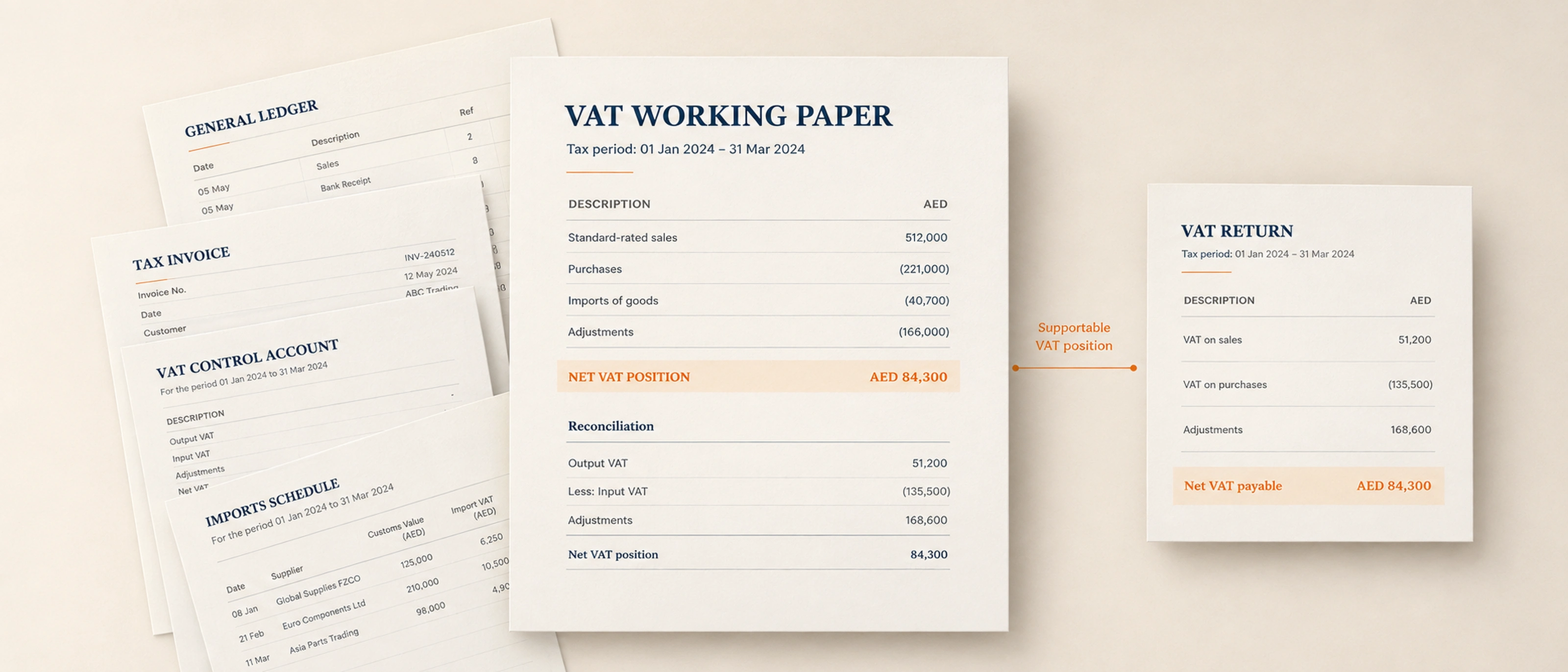
Period, registration position and responsibilities.
Transactions, VAT treatment and adjustments.
Ledgers, VAT controls and supporting records.
Exceptions, evidence gaps and assumptions.
Return review, filing and payment readiness.
We can work alongside your internal finance team or existing accounting provider. Where the underlying books require remediation, Accounting & Bookkeeping is scoped separately before VAT filing.
Some transactions require more than routine coding. Their treatment may depend on the nature of the supply, supporting evidence, place of supply, recovery rules and the business circumstances.
Imports, customs information and reverse-charge treatment should agree with the accounting and VAT records.
Zero-rated treatment should be supported by the relevant transaction facts and required evidence.
Being established in a free zone does not automatically remove a business from UAE VAT requirements. Special treatment for a Designated Zone applies only in relevant circumstances.
Recoverability may depend on the nature of the cost, its business use and the supporting tax documentation.
Timing differences, credit notes and current-period adjustments should be reflected consistently in the records and return workings.
New revenue streams, cross-border activity and changes in business structure may require a fresh review of VAT treatment.
The right service depends on whether the requirement concerns the current VAT cycle, a historic or FTA matter, or the condition of the underlying accounting records.
Key thresholds and timing for UAE VAT registration.
Registration depends on taxable activity
and the business’s circumstances.
Different rules can apply to
non-resident businesses.
Thresholds, timing, voluntary registration, free zones and application steps.
Last reviewed: August 2026 | General information only and not tax advice.
A UAE-resident business is generally required to register when its taxable supplies and imports exceed AED 375,000 over the previous 12 months, or are expected to exceed that amount in the next 30 days. Voluntary registration may be available when relevant taxable supplies, imports or taxable expenses exceed AED 187,500. Different rules apply to non-resident businesses, so the position should be assessed using the actual activities and circumstances.
The standard VAT Tax Period is generally three calendar months, although the FTA may assign a different period, including monthly reporting in some cases. VAT returns and any related payment are generally due within 28 days after the end of the assigned Tax Period. The business should follow the specific filing calendar shown in its EmaraTax account.
Records typically include sales and purchase ledgers, tax invoices, credit notes, customs documents, VAT control accounts and previous returns. We can work alongside an internal finance team or external accountant to reconcile these records, raise exceptions and prepare the return workings. Clear responsibilities and deadlines are agreed before the engagement begins.
Reliable VAT returns depend on sufficiently complete and reconciled accounting records. If the books are incomplete, unreconciled or lack supporting tax documentation, we first identify the outstanding work and its impact on the VAT position. Where necessary, accounting clean-up or catch-up work can be handled through a separate Accounting & Bookkeeping scope while appropriate VAT work continues where possible.
Yes. Free Zone status does not automatically remove a business from UAE VAT. The treatment depends on the specific transactions and whether the location is a Designated Zone meeting specific conditions. Free Zone businesses should assess registration and transaction treatment based on their actual operations.
A net refundable position may be carried forward or may support a refund request. However, a refund is not guaranteed simply because input VAT exceeds output VAT. The underlying transactions, recovery eligibility and supporting evidence should be reviewed carefully before submitting a refund application.
VAT deregistration depends on the circumstances. It may become mandatory where the business stops making taxable supplies or no longer meets the conditions for VAT registration, including where relevant taxable activity falls below the voluntary registration threshold and is not expected to exceed it in the applicable forward-looking period. Where deregistration is mandatory, the application generally must be submitted within 20 business days from the date the deregistration obligation starts. Businesses whose taxable activity remains above the voluntary threshold but below the mandatory threshold may need to assess whether voluntary deregistration is available.
Yes. VAT and Corporate Tax are separate UAE tax regimes with separate registration, return and compliance obligations. Being registered for VAT does not register a business for Corporate Tax, and a business must assess its obligations under both regimes independently.
The matter should first be assessed to determine the affected period, value and required response. Depending on the facts, a correction in a subsequent return or a Voluntary Disclosure may apply. We can support reviews of historic errors and FTA queries within an agreed scope, though we cannot guarantee penalty relief or specific FTA outcomes.
Fees depend on the registration status, assigned tax period, transaction volume, number of entities, VAT complexity, condition of the accounting records and whether historical issues exist. We review the starting position and provide a proposal based on the agreed scope rather than a generic package.
Registering, filing, correcting or reviewing a VAT treatment?
Tell us where matters stand. We’ll identify what needs attention next.